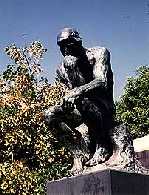
The W in Christmas
Forwarded by Shona Sadler 2011/12/07
|
Each December, I vowed to make Christmas a calm and peaceful experience. I had cut back on nonessential obligations - extensive card writing, endless baking, decorating, and even overspending. Yet still, I found myself exhausted, unable to appreciate the precious family moments, and of course, the true meaning of Christmas. My son, Nicholas, was in kindergarten that year. It was an exciting season for a six year old. For weeks, he'd been memorizing songs for his school's "Winter Pageant." I didn't have the heart to tell him I'd be working the night of the production. Unwilling to miss his shining moment, I spoke with his teacher. She assured me there'd be a dress rehearsal the morning of the presentation. All parents unable to attend that evening were welcome to come then. Fortunately, Nicholas seemed happy with the compromise. So, the morning of the dress rehearsal, I filed in ten minutes early, found a spot on the cafeteria floor and sat down. Around the room, I saw several other parents quietly scampering to their seats. As I waited, the students were led into the room. Each class, accompanied by their teacher, sat cross-legged on the floor. Then, each group, one by one, rose to perform their song. Because the public school system had long stopped referring to the holiday as "Christmas," I didn't expect anything other than fun, commercial entertainment songs of reindeer, Santa Claus, snowflakes and good cheer. So, when my son's class rose to sing, "Christmas Love," I was slightly taken aback by its bold title. Nicholas was aglow, as were all of his classmates, adorned in fuzzy mittens, red sweaters, and bright snowcaps upon their heads. Those in the front row- center stage - held up large letters, one by one, to spell out the title of the song. As the class would sing "C is for Christmas," a child would hold up the letter C. Then, "H is for Happy," and on and on, until each child holding up his portion had presented the complete message, "Christmas Love." The performance was going smoothly, until suddenly, we noticed her; a small, quiet, girl in the front row holding the letter "M" upside down - totally unaware her letter "M" appeared as a "W". The audience of 1st through 6th graders snickered at this little one's mistake. But she had no idea they were laughing at her, so she stood tall, proudly holding her "W". Although many teachers tried to shush the children, the laughter continued until the last letter was raised, and we all saw it together. A hush came over the audience and eyes began to widen. In that instant, we understood the reason we were there, why we celebrated the holiday in the first place, why even in the chaos, there was a purpose for our festivities. For when the last letter was held high, the message read loud and clear: And, I believe, He still is. Amazed in His presence... .humbled by His love. |
The Final Inspection
Forwarded by Jacques Boucher 2011/11/04
|
The soldier stood and faced God, Which must always come to pass. He hoped his shoes were shining, Just as brightly as his brass. 'Step forward now, you soldier, How shall I deal with you ? Have you always turned the other cheek ? To My Church have you been true?' The soldier squared his shoulders and said, 'No, Lord, I guess I ain't. Because those of us who carry guns, Can't always be a saint. I've had to work most Sundays, And at times my talk was tough. And sometimes I've been violent, Because the world is awfully rough. But, I never took a penny, That wasn't mine to keep... Though I worked a lot of overtime, When the bills got just too steep. And I never passed a cry for help, Though at times I shook with fear. And sometimes, God, forgive me, I've wept unmanly tears. I know I don't deserve a place, Among the people here. They never wanted me around, Except to calm their fears. If you've a place for me here, Lord, It needn't be so grand. I never expected or had too much, But if you don't, I'll understand. There was a silence all around the throne, Where the saints had often trod. As the soldier waited quietly, For the judgment of his God. 'Step forward now, you soldier, You've borne your burdens well. Walk peacefully on Heaven's streets, You've done your time in Hell.' Author Unknown |
Celebrating revenge killings signals deep moral change
By HENRY AUBIN, The Gazette May 7, 2011
|
I remember shuddering at film footage of
Sikhs in London dancing, cheering and setting off fireworks in response to the
assassination of Indira Gandhi in 1984. Such public revelry, I thought, was mercifully
foreign to the traditional Western belief in the sacredness of human life. I smugly
assumed we'd never see it in mainstream Western society. Wrong. If some of the response to Osama bin Laden's death this week is any sign, that belief is on the wane. Thousands of young Americans, mostly university students, cavorted, sang and waved flags in Times Square, in front of the White House, in Harvard Yard and on many other campuses. The crowds saw the al-Qaida leader's death as proper vengeance for his followers' attacks on iconic buildings that had killed thousands of civilians - not so different from those Sikhs (not all Sikhs) who regarded the prime minister of India's death as a fit reckoning for an attack by Indian troops on one of Sikhism's holiest sites, the Golden Temple, an operation causing hundreds of civilian deaths. The parallel detracted from my initial reaction to the raid, which was relief that bin Laden could commit no more crimes against humanity and admiration for the hit team's competence. Even if bin Laden was unarmed when shot, killing him was still an act of self-defence given his ability to inspire terrorism. But I wonder if partying in the streets is more than just bad taste and if it signals a deeper moral change. The mother of a young woman who died on 9/11 stated the traditional morality movingly. Interviewed on CBC's As It Happens, she said she could not share the students' joy: "In our family we do not celebrate death." She made the vital distinction between hating the sin but loving (or at least not hating) the sinner - a teaching that is central to the Judeo-Christian tradition and many other religions as well. When I grew up in the 1950s, that idea that death was not to be celebrated was still quite common in popular culture aimed at youngsters. In comic books and on the screen, my heroes Roy Rogers and the Lone Ranger would (with improbable marksmanship) shoot the guns out of villains' hands - implicitly, the bad guys still had a chance to turn their lives around. Today, in video games and in movies, the glory is in blasting the other guy into molecules. Wreaking bloody revenge is simply what heroes do. No wonder so many members of a generation raised on such fare went nuts over the daring bin Laden assassination. Here are some other views of a sort that don't get much airtime these days: - The Rev. Martin Luther King, Jr. in 1957: "Returning hate for hate multiplies hate, adding deeper darkness to a night already devoid of stars. Darkness cannot drive out darkness; only light can do that. Hate cannot drive out hate; only love can do that. Hate multiplies hate, violence multiplies violence, and toughness multiplies toughness in a descending spiral of destruction." - Rabbi Zvi Yehuda, of Cleve-land, this week: "In the ethics of Judaism, there can be no joy in any killing of any living being, particularly of a human ... We rejoice in eliminating evil, not in killing people." For an additional perspective, I called up one of the most conscientious people I know, Peter Brown, 71, a McGill professor, author of books on ecology and a Quaker. His take: "The whole handling of 9/11 is a tragic waste - no learning occurred about why the U.S. is so hated. What happened this week is the continuance of a revenge cycle. We should seek to understand our enemies - look at the world from their point of view, with an attempt to understand our role in what is playing out. A civilized person sees revenge cycles as primitive and barbaric - what we seek to rise above." Middle Eastern crowds sympathetic to terrorism revelled at bin Laden's success on 9/11. If we in the West respond in kind to our counterstrikes, bin Laden will have scored yet another success: He'll have dragged us away from our ethical moorings and into a spiral of endless hate. haubin@montrealgazette.com |
God's Sticky Notes
Received from Michèle Bitauld 2011-04-18
(from http://nubiagroup.blogspot.com)
|
Don't let your worries get the best of you. Remember: Moses started out as a basket case. Some people are kind, polite and sweet-spirited, until you try to sit in their pew. Many folks want to serve God but only as advisors. It is easier to preach ten sermons than it is to live one. When you get to your wit's end you'll find that God lives there. Opportunity may knock once, but temptation bangs on the door forever. God himself doesn't propose to judge a man until he is dead, so why should you? Peace starts with a smile Coincidence is when God chooses to remain anonymous. Don't put a question mark where God put a period. God doesn't call the qualified. He qualifies the called. God promises a safe landing, not a calm passage. The Will of God never takes you to where the Grace of God will not protect you. If God is your co-pilot, swap seats. Prayer: Don't give God instructions, just report for duty. The task ahead of us is never as great as the Power behind us. Life isn't about waiting for the storm to pass. It's about learning to dance in the rain. You can tell how big a person is by what it takes to discourage him. |
The Twelve Days of Christmas
Received from Ellen Johnstone 2010-12-08
|
There is one Christmas Carol that has always baffled me. What in the world do leaping lords,
French hens, swimming swans, and especially the partridge who won't come out of the pear tree
have to do with Christmas? This week, I found out. Ed Note: Snopes rips apart this interpretation, but what the heck? From 1558 until 1829, Roman Catholics in England were not permitted to practice their faith openly. Someone during that era wrote this carol as a catechism song for young Catholics. It has two levels of meaning: the surface meaning plus a hidden meaning known only to members of their church. Each element in the carol has a code word for a religious reality which the children could remember. -The partridge in a pear tree was Jesus Christ. -Two turtle doves were the Old and New Testaments. -Three French hens stood for faith, hope and love. -The four calling birds were the four gospels of Matthew, Mark, Luke & John. -The five golden rings recalled the Torah or Law, the first five books of the Old Testament. -The six geese a-laying stood for the six days of creation. -Seven swans a-swimming represented the sevenfold gifts of the Holy Spirit--Prophesy, Serving, Teaching, Exhortation, Contribution, Leadership, and Mercy. -The eight maids a-milking were the eight beatitudes. -Nine ladies dancing were the nine fruits of the Holy Spirit--Love, Joy, Peace, Patience, Kindness, Goodness, Faithfulness, Gentleness, and Self Control. -The ten lords a-leaping were the ten commandments. -The eleven pipers piping stood for the eleven faithful disciples. -The twelve drummers drumming symbolized the twelve points of belief in the Apostles' Creed. So there is your history for today. This knowledge was shared with me and I found it interesting and enlightening and now I know how that strange song became a Christmas Carol... so pass it on if you wish. Merry Christmas Everyone |
On Afghan Hills
Received from Tom Pavlasek 2009-11-11
While the Taliban drug business is in a boom. Busily the heroin they do distill, The Euro-American dope trade they must fill. And Alexander the Great's advice we did forget, That out of Afganistan it's hard to get. Tom Pavlasek 2008-11-11 |
The Talents You Have
Henry Van Dyke in the Montreal Gazette Quote of the Day 2009-08-09
for the woods would be very silent if no birds sang except the best. |
No Brainer
Received 20090728 in the Craig Travel E-News
|
One day a 6 year old girl was sitting in a classroom. The teacher was going to explain evolution to the children. The teacher asked
a little boy: Tommy do you see the tree outside? TOMMY: Yes. TEACHER: Tommy, do you see the grass outside? TOMMY: Yes. TEACHER: Go outside and look up and see if you can see the sky. TOMMY: Okay. (He returned a few minutes later) Yes, I saw the sky. TEACHER: Did you see God up there? TOMMY: No. TEACHER: That's my point. We can't see God because he isn't there. Possibly he just doesn't exist. A little girl spoke up and wanted to ask the boy some questions. The teacher agreed and the little girl asked the boy: LITTLE GIRL: TOMMY, do you see the tree outside? TOMMY: Yes. LITTLE GIRL: Tommy do you see the grass outside? TOMMY: Yessssss! LITTLE GIRL: Did you see the sky? TOMMY: Yessssss! LITTLE GIRL: Tommy, do you see the teacher? TOMMY: Yes LITTLE GIRL: Do you see her brain? TOMMY: No LITTLE GIRL: Then according to what we were taught today in school, she possibly may not even have one! |
Two Wolves
Forwarded 20090728 by Dianne Goodyear of Kingston, ON
|
One evening an old Cherokee told his grandson about a battle that goes on inside people.
He said, 'My son, the battle is between two wolves' inside us all. One is EVIL: It is anger, envy, jealousy, sorrow, regret, greed, arrogance, self-pity, guilt, resentment, inferiority, lies, false pride, superiority, and ego. The other is GOOD: It is joy, peace, love, hope, serenity, humility, kindness, benevolence, empathy, generosity, truth, compassion and faith. The grandson thought about it for a minute and then asked his grandfather: 'Which wolf wins? ' The old Cherokee simply replied, 'The one you feed.' |
The Shoe
Forwarded 20090203 by Beryl Reidl of Walkerton, Ontario
|
I showered and shaved............... I adjusted my tie. I got there and sat.............. In a pew just in time. Bowing my head in prayer......... As I closed my eyes. I saw the shoe of the man next to me..... Touching my own. I sighed. With plenty of room on either side...... I thought, "Why must our soles touch?" It bothered me, his shoe touching mine... But it didn't bother him much. A prayer began: "Our Father"............ I thought, "This man with the shoes.has no pride. They're dusty, worn, and scratched. Even worse, there are holes on the side!" "Thank You for blessings," the prayer went on. The shoe man said...............a quiet "Amen." I tried to focus on the prayer....... But my thoughts were on his shoes again. Aren't we supposed to look our best..... When walking through that door? Well, this certainly isn't it," I thought, Glancing toward the floor. Then the prayer was ended........... And the songs of praise began. The shoe man was certainly loud...... Sounding proud as he sang. His voice lifted the rafters......... His hands were raised high. The Lord could surely hear.... The shoe man's voice from the sky. It was time for the offering........ And what I threw in was steep. I watched as the shoe man reached.... Into his pockets so deep. I saw what was pulled out............ What the shoe man put in. Then I heard a soft "clink" .... as when silver hits tin. The sermon really bored me.......... To tears, and that's no lie. It was the same for the shoe man..... For tears fell from his eyes. At the end of the service........ As is the custom here. We must greet new visitors.... And show them all good cheer. But I felt moved somehow............. And wanted to meet the shoe man. So after the closing prayer.......... I reached over and shook his hand. He was old and his skin was dark..... And his hair was truly a mess. But I thanked him for coming......... For being our guest. He said, "My names' Charlie.......... I'm glad to meet you, my friend." There were tears in his eyes......... But he had a large, wide grin. "Let me explain," he said........... Wiping tears from his eyes. "I've been coming here for months.... And you're the first to say 'Hi.'" " I know that my appearance......... "Is not like all the rest. "But I really do try................. "To always look my best." "I always clean and polish my shoes.... "Before my very long walk. "But by the time I get here......... "They're dirty and dusty, like chalk." My heart filled with pain............ and I swallowed to hide my tears As he continued to apologize........ For daring to sit so near. He said, "When I get here........... "I know I must look a sight. "But I thought if I could touch you.. "Then maybe our souls might unite." I was silent for a moment........... Knowing whatever was said Would pale in comparison... I spoke from my heart, not my head. "Oh, you've touched me," I said...... "And taught me, in part; "That the best of any man............ "Is what is found in his heart." The rest, I thought,................. This shoe man will never know. Like just how thankful I really am... That his dirty old shoe touched my soul Just Me |
Came Riding With Gladness
By Carolyn Davis,
sung by Connie Osborne & Leslie Field at the 11 Jan 2009 Sunday Service.
|
Came riding with gladness men of old, To show Jesus their favor: praise God. Mix gladness with goodness: we get emotional gold--- Such feelings fine to savor, praise God. Refrain: Our God once touched the life-winding wheel, The human brain designing, He well thought, " I'll plant potential to feel High merriment and gladness." With God as guide the human race gropes (This view's from reverent divining). Evolve we in accord with God's hopes; Come less despair and sadness. And also with gladness came women and all. So, new carols we're singing: praise God. Base justice on love: each life should be a call. Hear joy bells, hear good bells all ringing, praise God. Refrain |
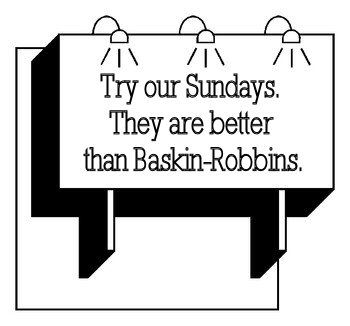
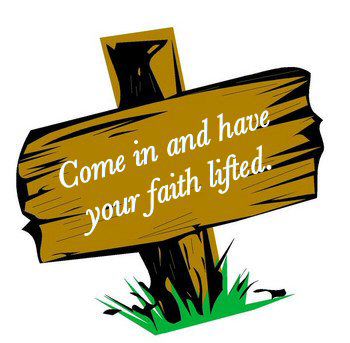
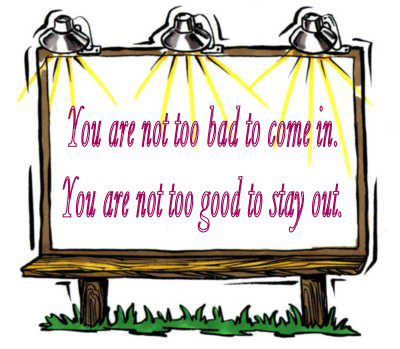
Church Signs
Forwarded 20090112 by Mary Guynan

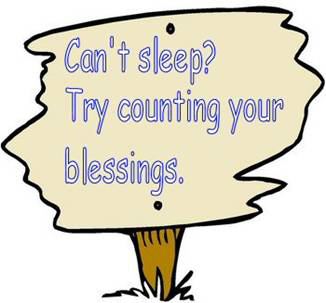 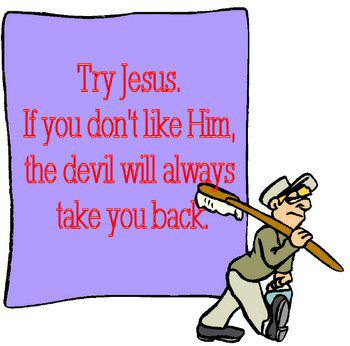

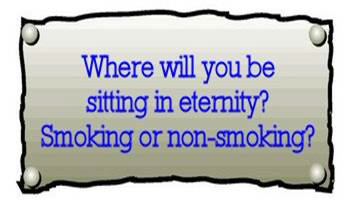
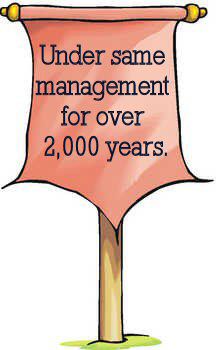
 |
Heaven and Hell
Forwarded 20081124 by Marion Golden
|
A Holy man was having a conversation with the Lord one day and said,
'Lord, I would like to know what Heaven and Hell are like.' The Lord led the holy man to two doors. He opened one of the doors and the holy man looked in. In the middle of the room was a large round table. In the middle of the table was a large pot of stew, which smelled delicious and made the holy man's mouth water. The people sitting around the table were thin and sickly. They appeared to be famished. They were holding spoons with very long handles that were strapped to their arms and each found it possible to reach into the pot of stew and take a spoonful. But because the handle was longer than their arms, they could not get the spoons back into their mouths. The holy man shuddered at the sight of their misery and suffering. The Lord said, 'You have seen Hell.' They went to the next room and opened the door. It was exactly the same as the first one. There was the large round table with the large pot of stew which made the holy man's mouth water. The people were equipped with the same long-handled spoons, but here the people were well nourished and plump, laughing and talking. The holy man said, 'I don't understand.' It is simple,' said the Lord. 'It requires but one skill. You see they have learned to feed each other, while the greedy think only of themselves.' |
Rite of Passage
Forwarded 20080411 by Shaun Priestman.
|
Do you know the legend of the Cherokee Indian youth's rite of passage? His father takes him into the forest, blindfolds him and leaves him alone. He is required to sit on a stump the whole night and not remove the blindfold until the rays of the morning sun shine through it. He cannot cry out for help to anyone. Once he survives the night, he is a MAN. He cannot tell the other boys of this experience because each lad must come into manhood on his own. The boy is naturally terrified. He can hear all kinds of noises. Wild beasts must surely be all around him. Maybe even some human might do him harm. The wind blows the grass and earth, and shakes his stump, but he sits stoically, never removing the blindfold. It's the only way he can become a man! Finally, after a horrific night, the sun appears and he removes his blindfold. Only then does he discover his father sitting on the stump next to him. He has been at watch the entire night, protecting his son from harm. |
Wheel of Life
Quote by Louisa Papatie, speaking in Algonquin at the hearing of the
commission looking into reasonable accommodation of immigrants.
From the Montreal Gazette 16 September 2007
No religion is better than another, no culture is better than another." |
Monsters in the Dark
Poem by Master Corporal Jeffrey Walsh, killed in Afghanistan 9 August 2006, written in February 2006.
From the Montreal Gazette 10 August 2006
I will not be ignorant any more. Pulling the blanket over my head will not keep them from coming ashore. Instead I choose to confront them as afraid as I might be, Because if I don't stop the monsters our children will never be free. |
Happiness Is
Email from retired Royal Canadian Air Force pilot Ken Olsen while suffering leukemia
to his daughter Carolyn - rec'd with the notice of his death April 26, 2006.
they just make the most of everything with what they've got. Happiness lies for those who cry, those who hurt, those who have searched and those who have tried, for only they can appreciate the importance of people who have touched their lives". |
Lasting Bequests
Sign on the door of the nursery at Christ Church United,
Two Mountains, Quebec, 2005-07-17
lasting bequests we can give our children - one is roots, the other, wings. |
Indian Prayer
From the memorial service for Julius Csisztu 14 May 2005
Do not stand at my grave and weep, I am not there, I do not sleep, I am a thousand winds that blow, I am the diamond glint on snow, I am the sunlight on ripened grain, I am the gentle autumn rain, When you wake in morning hush, I am the swift uplifting rush Of quiet birds in circling flight. I am the soft starlight at night. Do not stand at my grave and cry, I am not there, I did not die. |
ASAP
Forwarded 2005-04-07 by Dail Krujelskis
|
Ever wonder about the abbreviation A.S.A.P.? Generally we think of it in terms of even more hurry and stress in our lives. Maybe if we think of this abbreviation in a different manner, we will begin to find a new way to deal with those rough days along the way.  There's work to do, deadlines to meet;
You've got no time to spare, But as you hurry and scurry- ASAP - Always Say A Prayer In the midst of family chaos, "Quality time" is rare. Do your best; let God do the rest- ASAP - Always Say A Prayer It may seem like your worries Are more than you can bear. Slow down and take a breather- ASAP - Always Say A Prayer God knows how stressful life is; He wants to ease our cares, And He'll respond to all your needs ASAP - Always Say A Prayer |
Teddy
Forwarded by Joan McCauley August 5, 2003
|
As she stood in front of her 5th grade class on the very first day of
school, she told the children an untruth. Like most teachers, she
looked at her students and said that she loved them all the same. However, that
was impossible, because there in the front row, slumped in his seat, was a
little boy named Teddy Stoddard. Mrs. Thompson had watched Teddy the year before and noticed that he did not play well with the other children, that his clothes were messy and that he constantly needed a bath. In addition, Teddy could be unpleasant. It got to the point where Mrs. Thompson would actually take delight in marking his papers with a broad red pen, making bold X's and then putting a big "F" at the top of his papers. At the school where Mrs. Thompson taught, she was required to review each child's past records and she put Teddy's off until last. However, when she reviewed his file, she was in for a surprise. Teddy's first grade teacher wrote, "Teddy is a bright child with a ready laugh. He does his work neatly and has good manners... he is a joy to be around.." His second grade teacher wrote, "Teddy is an excellent student, well liked by his classmates, but he is troubled because his mother has a terminal illness and life at home must be a struggle." His third grade teacher wrote, "His mother's death has been hard on him. He tries to do his best, but his father doesn't show much interest and his home life will soon affect him if some steps aren't taken." Teddy's fourth grade teacher wrote, "Teddy is withdrawn and doesn't show much interest in school. He doesn't have many friends and he sometimes sleeps in class." By now, Mrs. Thompson realized the problem and she was ashamed of herself. She felt even worse when her students brought her Christmas presents, wrapped in beautiful ribbons and bright paper, except for Teddy's. His present was clumsily wrapped in the heavy, brown paper that he got from a grocery bag. Mrs. Thompson took pains to open it in the middle of the other presents. Some of the children started to laugh when she found a rhinestone bracelet with some of the stones missing, and a bottle that was one-quarter full of perfume.. But she stifled the children's laughter when she exclaimed how pretty the bracelet was, putting it on, and dabbing some of the perfume on her wrist. Teddy Stoddard stayed after school that day just long enough to say, "Mrs. Thompson, today you smelled just like my Mom used to." After the children left, she cried for at least an hour. On that very day, she quit teaching reading, writing and arithmetic. Instead, she began to teach children. Mrs. Thompson paid particular attention to Teddy. As she worked with him, his mind seemed to come alive. The more she encouraged him, the faster he responded. By the end of the year, Teddy had become one of the smartest children in the class and, despite her lie that she would love all the children the same, Teddy became one of her "teacher's pets." A year later, she found a note under her door, from Teddy, telling her that she was still the best teacher he ever had in his whole life. Six years went by before she got another note from Teddy. He then wrote that he had finished high school, third in his class, and she was still the best teacher he ever had in life. Four years after that, she got another letter, saying that while things had been tough at times, he'd stayed in school, had stuck with it, and would soon graduate from college with the highest of honors. He assured Mrs. Thompson that she was still the best and favorite teacher he had ever had in his whole life. Then four more years passed and yet another letter came. This time he explained that after he got his bachelor's degree, he decided to go a little further. The letter explained that she was still the best and favorite teacher he ever had. But now his name was a little longer.... The letter was signed, Theodore F. Stoddard, MD. The story does not end there. You see, there was yet another letter that spring. Teddy said he had met this girl and was going to be married. He explained that his father had died a couple of years ago and he was wondering if Mrs. Thompson might agree to sit at the wedding in the place that was usually reserved for the mother of the groom. Of course, Mrs. Thompson did. And guess what? She wore that bracelet, the one with several rhinestones missing. Moreover, she made sure she was wearing the perfume that Teddy remembered his mother wearing on their last Christmas together. They hugged each other, and Dr. Stoddard whispered in Mrs. Thompson's ear, "Thank you Mrs. Thompson for believing in me. Thank you so much for making me feel important and showing me that I could make a difference." Mrs. Thompson, with tears in her eyes, whispered back. She said, "Teddy, you have it all wrong. You were the one who taught me that I could make a difference. I didn't know how to teach until I met you." (For you who don't know, Teddy Stoddard is the Dr. at Iowa Methodist in Des Moines that has the Stoddard Cancer Wing.) |
Not in Vain
Forwarded by Dail Jacob Krujelskis 20040322
|
People gasped and whispered
and made faces as he made his way down the aisle and up onto the pulpit. He took off his hat and coat. My heart sank. There stood our preacher. He was the "homeless man." No one said a word. The preacher took his Bible and laid it on the stand. "Folks, I don't think I have to tell you what I am preaching about today." Then he started singing the words to this song.
If I can cheer somebody with a word or song. If I can show somebody that he's traveling wrong. Then my living shall not be in vain."
Mercy - When you don't get what you deserve. Grace - When you get what you don't deserve. |
The Garden
Forwarded by Dail Jacob Krujelskis 20040228
|
Come to the garden alone, while the dew is still on the roses.... FOR THE GARDEN OF YOUR DAILY LIVING, PLANT THREE ROWS OF PEAS: 1. Peace of mind 2. Peace of heart 3. Peace of soul PLANT FOUR ROWS OF SQUASH: 1. Squash gossip 2. Squash indifference 3. Squash grumbling 4. Squash selfishness PLANT FOUR ROWS OF LETTUCE: 1. Lettuce be faithful 2. Lettuce be kind 3. Lettuce be patient 4. Lettuce really love one another NO GARDEN IS WITHOUT TURNIPS: 1. Turnip for meetings 2. Turnip for service 3. Turnip to help one another TO CONCLUDE OUR GARDEN WE MUST HAVE THYME: 1. Thyme for each other 2. Thyme for family 3. Thyme for friends WATER FREELY WITH PATIENCE AND CULTIVATE WITH LOVE. THERE IS MUCH FRUIT IN YOUR GARDEN BECAUSE YOU REAP WHAT YOU SOW. |
The World is Mine
Received from Dail Jacob Krujelskis 20040228
|
Today, upon a bus, I saw a very beautiful woman. And wished I were as beautiful. When suddenly she rose to leave, I saw her hobble down the aisle. She had one leg and wore a crutch. But as she passed, she passed a smile. Oh, God, forgive me when I whine. I have two legs; the world is mine. I stopped to buy some candy. The lad who sold it had such charm. I talked with him, he seemed so glad. If I were late, it'd do no harm. And as I left, he said to me, "I thank you, you've been so kind. It's nice to talk with folks like you. You see," he said, "I'm blind." Oh, God, forgive me when I whine. I have two eyes; the world is mine. Later while walking down the street, I saw a child I knew. He stood and watched the others play, but he did not know what to do. I stopped a moment and then I said, "Why don't you join them dear?" He looked ahead without a word. I forgot, he couldn't hear. Oh, God, forgive me when I whine. I have two ears; the world is mine. With feet to take me where I'd go. With eyes to see the sunset's glow. With ears to hear what I'd know. Oh, God, forgive me when I whine. I've been blessed indeed, the world is mine. |
I Love It
(Source unknown)
|
The 92-year-old, petite, well-poised and proud lady,
who is fully dressed each morning by eight o'clock,
with her hair fashionably coifed and makeup perfectly applied,
even though she is legally blind, moved to a nursing home today.
Her husband of 70 years recently passed away, making the move necessary. After many hours of waiting patiently in the lobby of the nursing home, she smiled sweetly when told her room was ready. As she maneuvered her walker to the elevator, I provided a visual description of her tiny room, including the eyelet sheets that had been hung on her window. "I love it," she stated with the enthusiasm of an eight-year-old having just been presented with a new puppy. "Mrs. Jones, you haven't seen the room .... just wait." "That doesn't have anything to do with it," she replied. "Happiness is something you decide on ahead of time. Whether I like my room or not doesn't depend on how the furniture is arranged... it's how I arrange my mind. I already decided to love it ... "It's a decision I make every morning when I wake up. I have a choice; I can spend the day in bed recounting the difficulty I have with the parts of my body that no longer work, or get out of bed and be thankful for the ones that do. Each day is a gift, and as long as my eyes open I'll focus on the new day and all the happy memories I've stored away ... just for this time in my life. Old age is like a bank account ... you withdraw from what you've put in .. So, my advice to you would be to deposit a lot of happiness in the bank account of memories. Thank you for your part in filling my Memory bank. I am still depositing. Remember the five simple rules to be happy: 1. Free your heart from hatred. 2. Free your mind from worries. 3. Live simply. 4. Give more. 5. Expect less. |
Family
(Source unknown)
|
Are you aware that if we died tomorrow, the
company that we are working for could easily
replace us in a matter of days. But the family we left
behind will feel the loss for the rest of their lives. And come to think of it, we pour ourselves more into work than into our own family, an unwise investment indeed, don't you think? So what is behind the story? Do you know what the word FAMILY means? FAMILY = Father And Mother I Love You. |
In Flanders Fields
|
"In Flanders Fields" was first published in England's "Punch" magazine in December, 1915. Within months, this poem came to symbolize the sacrifices of all who were fighting in the First World War. Today, the poem continues to be a part of Remembrance Day ceremonies in Canada and other countries. The poem was written by a Canadian - John McCrae, a doctor and teacher, who served in both the South African War and the First World War. Source = http://www.vac-acc.gc.ca/general/sub.cfm?source=history/firstwar/mccrae |
|
In Flanders fields the poppies blow Between the crosses, row on row, That mark our place; and in the sky The larks, still bravely singing, fly Scarce heard amid the guns below. We are the Dead. Short days ago We lived, felt dawn, saw sunset glow, Loved, and were loved, and now we lie In Flanders fields. Take up our quarrel with the foe: To you from failing hands we throw The torch; be yours to hold it high. If ye break faith with us who die We shall not sleep, though poppies grow In Flanders fields. |
Cuttyhunk Quotes
A couple of quotes from web site http://members.aol.com/cuttyhunk/index.html
|
Friends are Angels Who lift us to our feet When our own wings have trouble Remembering how to Fly. Fear knocked on the door.... Faith answered and found no one there. |
God's Boxes
Forwarded by Mary Guynan 20040119
|
I have in my hands two boxes, Which God gave me to hold. He said, "Put all your sorrows in the black box, And all your joys in the gold." I heeded His words, and in the two boxes, Both my joys and sorrows I stored, But though the gold became heavier each day, The black was as light as before. With curiosity, I opened the black, I wanted to find out why, And I saw, in the base of the box, a hole, Which my sorrows had fallen out by. I showed the hole to God, and mused, "I wonder where my sorrows could be!" He smiled a gentle smile and said, "My child, they're all here with me." I asked God, why He gave me the boxes, Why the gold and the black with the hole? "My child, the gold is for you to count your blessings, The black is for you to let go." We should consider all of our friends a blessing. Send this to a friend today just to let them know you are thinking of them and that they are a joy in your life. A ball is a circle, no beginning, no end. It keeps us together like our Circle of Friends. But the treasure inside for you to see, Is the treasure of friendship you've granted to me. |
Morals
Quoted in the Montreal Gazette fall 2003
More Inspiring Thoughts
Forwarded by Mary Guynan Sep 7, 2003
|
Love...and you shall be loved. The real measure of a man's wealth is what he has invested in eternity. It's important for parents to live the same things they teach. Thank God for what you have, Trust God for what you need. If you fill your heart with regrets of yesterday and the worries of tomorrow, you have no today to be thankful for. Man looks at outward appearance but the Lord looks within. The choice you make today will usually affect tomorrow. If anyone speaks badly of you, live so none will believe it. Patience is the ability to idle your motor when you feel like stripping your gears. Love is strengthened by working through conflicts together. The best thing parents can do for their children is to love each other. Harsh words break no bones but they do break hearts. To get out of a difficulty, one usually must go through it. We take for granted the things that we should be giving thanks for. Love is the only thing that can be divided without being diminished. Happiness is enhanced by others but does not depend upon others. Do what you can, for whom you can, with what you have, and where you are. Author Unknown |
Gratitude
Quote in the Montreal Gazette July 21, 2003
|
Gratitude is merely the secret hope of further favours. François de la Rochefoucauld
|
The Carpenter
Forwarded by Diane Goodyear
|
Once upon a time two brothers who lived on adjoining farms fell into conflict. It was the first serious rift in 40 years of farming side by side, sharing machinery, and trading labor and goods as needed without a conflict. Then the long collaboration fell apart. It began with a small misunderstanding and it grew into a major difference, and finally it exploded into an exchange of bitter words followed by weeks of silence. One morning there was a knock on John's door. He opened it to find a man with a carpenter's tool box. "I'm looking for a few days' work" he said. "Perhaps you would have a few small jobs here and there I could help with? Could I help you?" "Yes," said the older brother. "I do have a job for you. Look across the creek at that farm. That's my neighbor, in fact, it's my younger brother. Last week there was a meadow between us and he took his bulldozer to the river levee and now there is a creek between us. Well, he may have done this to spite me, but I'll do him one better. See that pile of lumber by the barn? I want you to build me a fence, an 8-foot fence so I won't need to see his place or his face anymore. The carpenter said, "I think I understand the situation". Show me the nails and the post-hole digger and I'll be able to do a job that pleases you." The older brother had to go to town, so he helped the carpenter get the materials ready and then he was off for the day. The carpenter worked hard all that day measuring, sawing, nailing. About sunset when the farmer returned, the carpenter had just finished his job. The farmer's eyes opened wide, his jaw dropped. There was no fence there at all. It was a bridge -- a bridge stretching from one side of the creek to the other! A fine piece of work, handrails ! and all -- and the neighbor, his younger brother, was coming toward them, his hand outstretched. "You are quite a fellow to build this bridge after all I've said and done." The two brothers stood at each end of the bridge, and then they met in the middle, taking each other's hand. They turned to see the carpenter hoist his toolbox on to his shoulder. "No, wait! Stay a few days. I've a lot of other projects for you," said the older brother. "I'd love to stay on," the carpenter said, "but, I have many more bridges to build". |